Why Your Creator Marketing Keeps Breaking Down And How to Fix the Part Nobody Talks About
I talk to vacation rental operators every week, and almost every one who has tried creator marketing tells me some version of the same story.
They found a creator. The creator had a good following, the right aesthetic, an audience that looked like their guest. They offered a free stay. The creator came — or sometimes didn’t come at all — and either way, the content was never delivered.
One host I spoke with recently put it better than I’ve heard anyone put it:
“I can find creators. What I can’t do efficiently is get one to actually commit and show up. Even worse, the last one showed up but never delivered content, and landed the review on the wrong property.”
That sentence contains the entire problem.
It’s not a reach problem. It’s not a budget problem. It’s not even really a creator problem. It’s an accountability problem, and most of the advice that exists about creator marketing for vacation rentals never addresses it at all.
The Gap Between Creator Marketing Works and Creator Marketing Works For Me
The case for creator marketing in vacation rentals is well established. Creator marketing is becoming one of the most effective ways for travelers to discover, evaluate, and book accommodations. Micro-influencers consistently outperform paid ads on trust and engagement. A single well-placed Reel from a creator whose audience trusts her judgment (like this one by thecanceriantraveler) is worth more than a hundred targeted ad impressions to someone who’s never heard of your property.
The operators building real creator programs — structured, ongoing, tracked — are seeing the kind of results that change a business. A $30,000 annual budget. Nearly $2 million in attributed revenue. 600 leads per month. 93% direct bookings. Not because the creators were famous, but because the system behind the creators was built to work.
So why are so many operators trying creator marketing, getting burned, and walking away?
Because there’s a gap between “creator marketing works as a strategy” and “creator marketing works for my specific property right now” and that gap is almost entirely an operational one.
“The travel and hospitality industry sees an average ROI of $7.65 for every dollar spent on influencer marketing — and 72% of travelers consider the opinions of influencers when making travel-related decisions.” — Market.us Influencer Marketing Statistics 2026
What Actually Goes Wrong
When a creator stay fails to produce results, it almost always traces back to one of four places:
- No written agreement before the stay. The most common failure mode. A creator is invited, a stay is offered, content is promised, and none of it is in writing. When the content doesn’t arrive, there’s no recourse. No timeline was agreed on, no deliverables were specified, no consequences were defined. The host gave away their inventory with nothing to enforce.
- The brief was vague or didn’t exist. A creator who arrives without a clear brief will create content that serves their audience, not your booking objectives. That might mean beautiful content that generates saves and zero direct bookings. Or content that focuses on their experience rather than your property’s differentiators. Or worse, content that tags the wrong location entirely.
- The creator was the wrong match. Follower count is not a proxy for audience fit. A creator with 80,000 followers whose audience is predominantly male college students is the wrong match for a romantic cabin retreat, regardless of how beautiful their content is. Matching requires understanding the guest profile on both ends, what the creator’s audience actually does, not just who they are.
- There was no accountability layer after the stay. Even with an agreement, follow-through requires follow-up. Creators have multiple brand partnerships, editorial calendars, and life events that compete with your content timeline. Without someone managing the relationship after the stay — checking in, nudging, enforcing the timeline — content slips and hosts have no visibility into why.
Content deliverables and timeline — what posts are expected, on which platforms, within how many days of the stay — are non-negotiable. A well-structured brief protects both parties and produces better content because the creator knows exactly what they’ve agreed to. Most hosts understand this in theory. The problem is the execution layer: who actually does this work, consistently, for every creator, for every stay.
Why "Just Be More Organized" Isn't the Answer
The natural response to this list is: fix your process. Write better agreements. Create a brief template. Follow up more diligently. That advice is correct and it doesn’t work.
It doesn’t work because the operational overhead of running a real creator program — finding creators, vetting them, negotiating terms, drafting agreements, managing briefs, following up on content, enforcing timelines, tracking attribution — is a part-time job sitting on top of an already full operational plate. After working with nearly 500 creators across travel and hospitality, the gap between properties that grow and properties that plateau is almost never the quality of their content. It is the absence of a system behind it.
The operators who gave up on creator marketing didn’t give up because it doesn’t work. They gave up because the system required to make it work is more than most hosts can build and maintain alongside everything else they’re managing.
This is the real problem. Not strategy. Not reach. Not budget. Operations.
What a Creator System That Actually Works Looks Like
A written agreement signed before the stay is confirmed. Not a terms-of-service click-through. A document that specifies: the exact deliverables (number of posts, platforms, formats), the timeline (content published within X days of checkout), usage rights (who owns what and for how long), and what happens if the content isn’t delivered.
A goal-aligned brief delivered before arrival. Not a list of things to photograph. A clear articulation of what the content needs to accomplish — for whom, in what season, toward what booking goal — and the two or three specific aspects of the property that are most important to show.
A relationship management layer that runs after checkout. Someone who follows up at the agreed timeline, provides feedback on drafts if needed, and enforces the agreement without being adversarial about it. This is the part most hosts skip and the part that determines whether the system actually delivers.
A tracking mechanism that connects content to outcomes. A unique referral code or UTM-tagged link or custom booking code attached to every creator partnership so that when a booking eventually comes in — 30, 60, or 90 days after the content was published — you can trace it back to the creator who generated the interest. Without this, you can’t know what’s working.
The Inventory Window Most Hosts Are Missing
There’s a specific opportunity hiding in most vacation rental calendars that creator marketing is perfectly suited to fill and most operators haven’t connected the two.
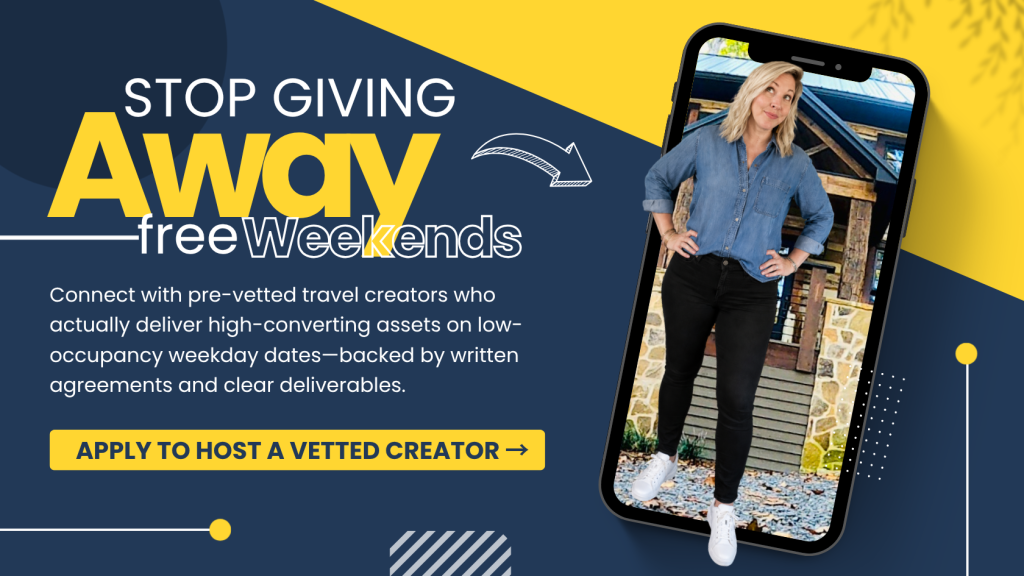
Weekday inventory. Specifically Sunday through Thursday stays, in shoulder seasons and transitional months.
These are the dates that are hardest to fill through OTA algorithms and paid ads, and the exact inventory that makes sense to allocate to creator partnerships. A creator stay that fills a Tuesday and Wednesday in October. Dates that might otherwise sit empty costs nothing in lost revenue and produces content assets that can drive bookings for months afterward.
Fall color windows in mountain, lake, and outdoor destinations are particularly high-value for this. A Reel filmed at peak fall color in October performs through November and can seed bookings for the following fall. The content has a longer shelf life than the season itself.
If you have weekday inventory and you’re not filling it with structured creator stays, you’re leaving both content and commission-free bookings on the table.
What This Looks Like in Practice
Here’s what I mean by a system rather than a campaign.
At ReTreet Resort, I built a creator program from scratch on a $30,000 annual marketing budget. One to two creators per week, every week, for two years. Creators had a signed agreement before arrival. Every stay had a brief. Content had a tracking code. Every relationship had a follow-up sequence after checkout.
The result wasn’t one viral post. It was 600 leads per month, a 34% conversion rate, and 93% direct bookings because the system compounded instead of resetting with every new creator.
The program worked not because the creators were exceptional but because the accountability infrastructure made it impossible for the system to fail quietly. When something went wrong — and occasionally it did — there was a clear process for addressing it.
That’s what separates a creator program from a series of creator experiments.
The Practical Question Most Hosts Ask Next
If you’ve read this far and recognized your own experience somewhere in it. The no-show, the wrong-property review, the content that never arrived and the honest question is: what’s actually realistic for me to build?
For most operators, the answer is: more than you think, but less than you’d want to do alone.
The agreement template, the brief framework, the vetting checklist, the tracking setup — these are buildable. I’ve documented all of them and they’re available as part of the Creator Marketing for Vacation Rentals guide →.
The ongoing management layer, someone who knows which creators are worth introducing to your specific property, vets them against your guest profile, manages the relationship from agreement to content delivery, and troubleshoots when things go sideways — is the piece most operators can’t add to an already full plate.
That’s the specific problem the ongoing partnership is designed to solve.
The Ongoing Creator Partnership Program
For operators who want the system running without having to run it themselves, I offer a monthly retainer that covers:
- One guaranteed creator pairing per month — vetted, matched to your guest profile, confirmed on your calendar
- Agreement and brief management — I handle the paperwork and the expectations on both sides before anyone travels
- Accountability follow-through — I manage the post-stay relationship and ensure content is delivered per the agreement
- A monthly strategy call — one hour to review what’s working, what’s not, and what’s coming next
- The full creator marketing system — SOPs, agreement templates, tracking setup, and implementation guide so you understand what’s being built on your behalf
- $250 per month. Cancel anytime after month three.
This is not a management fee for a full creator agency. It’s the operational layer that makes the system work. The piece between “I know creator marketing should work for my property” and “I have a confirmed creator on my calendar next month and content arriving 10 days after checkout.”
If you have weekday inventory sitting open on your calendar and you’d like content that actually gets delivered, here’s where to apply →
The One Thing Worth Doing Before Anything Else
Before you invest in any creator program — mine or anyone else’s — do this: Go back to the last creator stay that didn’t work. Ask yourself, was there a written agreement? If not, that’s where the system broke. Everything else, the wrong creator, the missing content, the review on the wrong property is downstream of that one missing piece.
The agreement is not bureaucracy. It’s the difference between a creator marketing program and a series of free stays that may or may not produce anything. Build that piece first, and the rest follows.
For the full system behind building a creator program that compounds — vetting, briefs, tracking, and attribution — Creator Marketing for Vacation Rentals: How to Build a Program That Drives Bookings (Not Just Content) →
I’m Sarah Stahl, a hospitality marketing strategist helping vacation rental and boutique hospitality brands win direct bookings and own their demand. My specialty is creator systems: structured programs that turn creators into a steady source of direct bookings, not one-off posts. I’ve worked with nearly 500 creators and built the system that took ReTreet Resort from six treehouses to 21 units at 93% direct bookings without relying heavily on PPC. I’ve since applied it at Wilding Hotels, where direct bookings rose 50%, and now bring it to hotels and short-term rental managers as founder of Market Movers.
Ready to see what that looks like for your property? Book a Strategy Call