Creator Marketing for Vacation Rentals: Why Campaigns Fail and Programs Compound
On creator marketing, borrowed trust, and why brand safety is asking the wrong question. Sarah Stahl spoke at The Uprising on micro-creators and the future of trust-based marketing as a result working with 500+ creators in travel, hospitality & local lifestyle.
From what I’ve experienced, many vacation rental operators approach creator marketing the same way.
They identify a travel influencer with a large following. They offer a complimentary stay in exchange for a few posts. The content goes live, the views are good, the comments are enthusiastic, and then nothing happens. No bookings they can trace. No leads in the CRM. No way to know whether the stay paid for itself.
They conclude that creator marketing doesn’t work. Then they try paid ads instead.
What they actually experienced wasn’t creator marketing failing. It was the absence of a system. One creator stay is not a program. A few posts with no tracking is not a strategy. And hype — however well-produced — is not the same as trust.
Creator marketing for vacation rentals works and I have the real-world experience and numbers to prove it. But it only works when it’s built as a program, not executed as a tactic. This post is the framework behind the difference.
Why Creator Marketing Works Differently for Vacation Rentals
Before building anything, it’s worth understanding why creator marketing is unusually well-suited to vacation rental and hospitality, and why the standard influencer playbook (big reach, single campaign, brand awareness) consistently underperforms in this category.
Vacation rental bookings are high-consideration purchases. A family booking a week-long lake house isn’t making an impulse decision the way someone buys a product they see on TikTok. They’re committing several thousand dollars to an experience they can’t physically inspect first, in a place they’ve never been, from a host they’ve never met.
That decision does not get settled at the awareness level, it requires trust.
The question a guest is actually answering when they decide to book isn’t “have I heard of this property?” It’s “do I believe this place is worth it, and do I believe the host will deliver on what the listing promises?”
That’s exactly what a well-executed creator stay answers. A real person, with a real audience that trusts their judgment, sharing a real experience at your property — in their own voice, on their own terms — generates the kind of contextual credibility that no ad creative can manufacture.
The data supports this at scale. Micro-influencers with 10K–100K followers generate 3.86% average engagement rates compared to 1.21% for mega-influencers, at costs 60% lower per post. For vacation rentals specifically, the case for micro-creators over macro ones is even stronger — a travel creator with 25,000 highly engaged followers in your target demographic is worth more than a celebrity with 2 million passive ones, because her audience actually trusts her enough to book where she stays.
Research shows that 75% of creators say brand-curated creator communities increase their loyalty to the brand. That loyalty compounds. A creator who has stayed at your property and had a genuinely good experience will mention it organically, link to it in future content, and refer other creators to you — none of which requires additional spend.
The mechanism that makes creator marketing for vacation rentals work is trust transfer. When a guest’s trusted creator says “this is worth staying,” the skepticism that would otherwise make them hesitate to book dissolves. That’s not hype, it’s the most efficient trust-building tool available to a property that can’t rely on brand recognition.
The Difference Between a Creator Campaign and a Creator Program
This distinction is the foundation of everything that follows.
A creator campaign is an isolated marketing activation. One creator. One stay. One round of posts. You measure it by looking at the content’s engagement and making a judgment call about whether it was “worth it.” Most of the time, the judgment is vague because the tracking wasn’t built in, and the ROI can’t be calculated because there’s no baseline to compare it to.
A creator program is a sustained marketing system. Multiple creators. An ongoing cadence. Structured expectations, consistent tracking, and results that compound over time because each creator stay builds on the credibility established by the ones before it.
The difference in outcome between the two is not marginal. It’s categorical and there are clear reasons they fail.
When I was hired as the fourth employee at ReTreet Resort & Spa — a startup treehouse property competing against nationally recognized brands on a $30,000 annual marketing budget. Early on we made a deliberate choice. We weren’t going to run a creator campaign, we were going to build a creator program.
One to two creators per week, every week, for two years. Not celebrities. Not travel accounts with millions of followers. Real people with real audiences telling the truth about a real place — in their own voice, on their own terms, on a schedule we could sustain.
Over two years, that system reached nearly 500 creators in the travel and lifestyle space. It generated nearly $2 million in attributed revenue. Six hundred leads per month at its maturity. A 34% lead-to-booking conversion rate. And it was the primary driver of the property reaching 93% direct bookings — not a supplement to a paid media strategy, not a brand awareness exercise, the actual demand engine of the business.
The distinction between campaign and program explains everything. Here’s how to build the program version.
Step 1: Define What "Success" Means Before the First Stay
The most common reason creator marketing for vacation rentals fails is that success was never defined before the creator arrived. Without a definition, you’re measuring vibes and vibes don’t tell you whether to scale what’s working or fix what’s breaking. Before booking your first creator stay, establish these four metrics:
- Tracking mechanism per creator. Every creator gets a unique referral code, UTM link, or dedicated landing page. This is non-negotiable. Without it, you cannot attribute a booking to a creator even if that creator directly caused it — because the guest will bounce between platforms, research your property, and eventually book through your direct channel or an OTA with no trail back to the creator who started the journey.
- Lead capture event. A booking is a lagging indicator. What is the leading indicator that tells you demand is building? For most programs, it’s a trackable action: a discount code download, a form submission on a dedicated landing page, an email signup attached to a direct booking offer. Build this before the creator posts, because their content will drive people somewhere — make sure that somewhere captures something.
- Content deliverables and timeline. What posts are expected, on which platforms, within how many days of the stay? This isn’t micromanagement — it’s professional clarity. A well-structured brief protects both parties and produces better content because the creator knows exactly what they’ve agreed to.
- 90-day attribution window. A traveler who sees a creator’s Instagram Reel on a Tuesday doesn’t book by Wednesday. They come back to it. They research the property. They talk to their partner. They check dates three weeks later. Attribution in vacation rental creator marketing requires a longer window than a product purchase — 90 days is the industry standard; some programs use 180.
Step 2: Find and Vet the Right Creators (Without Expensive Software)
You don’t need a platform subscription or an agency to find creators worth working with. You need a clear picture of who your guest actually is, and the discipline to match that profile to creator audiences before you offer a stay.
Finding creators:
Start with your own guests. The most powerful creators you can work with are people who would have stayed at your property even without an invitation — because their content will be authentic in a way that invited-only guests rarely achieve. Search your existing guests’ social handles. Look for guests who have already posted about your property without being asked. These people are your warmest possible creator relationships.
Search hashtags and locations. Search the hashtag for your destination, your nearest town, nearby attractions, and the type of experience you offer (lake house, treehouse, mountain cabin). The creators posting this content are already creating demand for your category — they just haven’t stayed with you yet.
Look for travel creators within a specific follower range: 5,000–100,000. This is the micro-influencer tier that delivers the highest engagement-to-cost ratio for vacation rental creator marketing. Micro-influencers consistently deliver higher ROI than mega-influencers, with engagement rates 3x higher at 60% lower cost.
Vetting creators (the questions that actually matter):
- Does this creator’s audience match the demographic of a guest who would book my property? Not “do they have a lot of followers” but “do their followers look like my guests?”
- What is their engagement rate? Divide total likes and comments on their last 10 posts by their follower count. Under 1% is weak. 3–5% is solid for this size. Above 5% is excellent.
- Do their followers comment in a way that suggests actual trust and relationship, or do the comments look like generic emoji responses? Read them. It takes 90 seconds and tells you more than any metric.
- Have they done paid partnerships before? Look at how they disclose them. Do they read as authentic, or do they read as advertisements?
- What does their audience do after seeing their travel content? Check if they mention booking recommendations in comments, or ask for details — that’s evidence of intent transfer.
Step 3: Set the Terms That Protect Your Business
This is the section that separates operators who run creator programs sustainably from operators who run them until they’re exhausted and burned out.
The boundaries you need to set aren’t about being difficult. They’re about being operationally sound. A creator program that disrupts your operations, fills your most profitable calendar windows with complimentary stays, or produces content you can’t stand behind isn’t a marketing investment — it’s a cost with no return.
The terms that matter most:
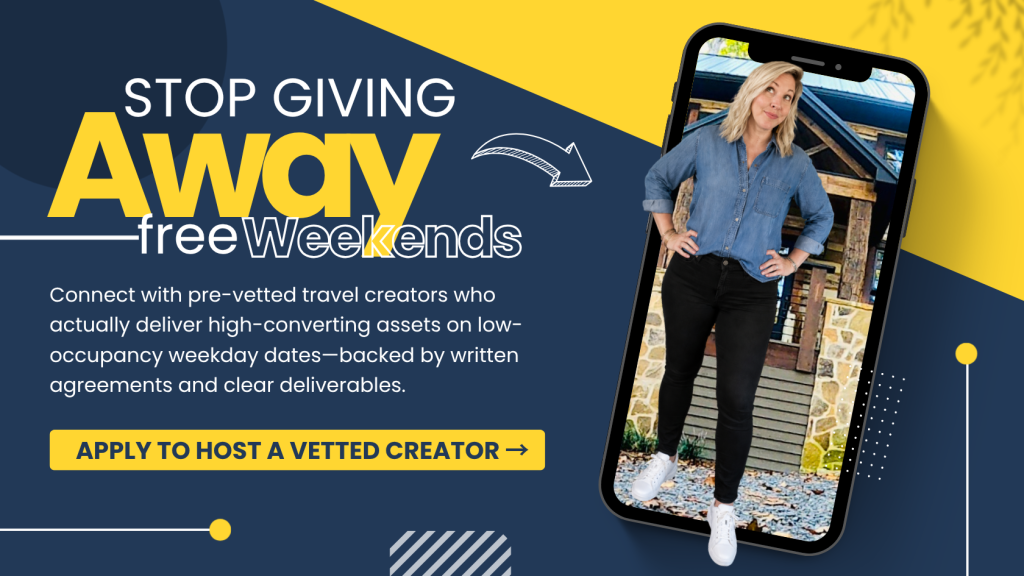
No weekend or peak-season stays. Complimentary stays should fill your lowest-demand windows — Tuesday through Thursday shoulder season, low-demand months, dates that would otherwise be dark on your calendar. Peak weekends are your highest-margin inventory. Giving them away for content is the single fastest way to make a creator program unprofitable.
Cleaning fee required. A creator stay should not be entirely free to your business. Requiring the creator to pay the cleaning fee accomplishes two things: it filters out creators who aren’t genuinely interested in your property (they’ll decline), and it covers the real cost of the stay so the complimentary element is the accommodation, not the whole operation.
Minimum deliverables. Be specific: two Instagram posts, one Reel, three Stories with a link to your direct booking page, published within seven days of checkout. Vague expectations produce vague results. Specific agreements produce specific content.
Approval process for property-specific claims. Your property has unique attributes — capacity, pet policy, availability, booking terms. Ask creators to send captions for review before posting anything that makes specific claims about the property. You don’t review for creative quality — you review for factual accuracy.
Referral code required. Every creator gets a unique code before arrival, not after. If the code isn’t created before the stay, the tracking isn’t built, and the ROI can’t be calculated. No exceptions.
Research shows that when brands invest in genuine relationships with creators, creators respond with deeper commitment, better ideas, and stronger performance. Clear expectations aren’t the enemy of authentic content. They’re the foundation of a relationship that produces it consistently.
Step 4: Brief Creators Well — Then Let Them Work
The brief is where most operators get this wrong in one of two ways: either they provide no guidance at all (and the creator posts whatever they feel like), or they script the content so tightly that the authenticity — the entire reason the creator’s audience trusts them — evaporates.
The goal of the creator brief is to give the creator the box, not the manual. Define the boundaries; give complete creative freedom inside them.
What belongs in the brief:
- The property’s story in two or three sentences: what it is, where it is, and what kind of experience it creates
- The direct booking URL and referral code, with a clear request to use them
- The specific deliverables agreed upon (platforms, formats, quantity, timeline)
- One or two experiences you want highlighted — the views from the deck at sunrise, the outdoor shower, the private dock — not scripted captions, just an invitation to discover them
- Any factual information the creator needs to be accurate (pet policy, capacity, check-in process)
- What the creator should not do (mention competitors, photograph guests without consent, share personal contact information)
What doesn’t belong in the brief:
Scripts. Suggested captions. Lists of adjectives you’d like them to use. Required hashtags beyond one or two. Approval of creative direction before posting.
The authenticity of a creator’s content is the product you’re paying for. Overcorrecting for brand safety at the expense of authentic voice is the fastest way to produce content that performs exactly like an ad — because it is one.
Step 5: Build the System That Converts Creator Traffic Into Bookings
This is the step most operators skip because they’re focused on the content rather than what happens after someone sees it.
Creator content generates two things: reach and intent. Reach means people saw it. Intent means people were interested enough to want to know more. The conversion gap — the space between “interested enough to look” and “committed enough to book” — is where the program either pays off or leaks.
To close that gap, three things need to be in place before the creator’s first post goes live:
- A direct booking path that works. If someone sees a creator’s content and clicks through to your property, the experience they land on determines whether they book or bounce. Your direct booking website needs to load in under three seconds on mobile, show transparent pricing without surprise fees at checkout, and complete a reservation in fewer than five steps. Test this before the creator goes live — because the traffic is coming whether you’re ready or not.
- A lead capture mechanism. Most people who see creator content and feel genuine interest are not ready to book within 48 hours. They need time, comparison shopping, a conversation with their partner. Your job is to capture them before they disappear. A direct booking offer — a seasonal discount code, a direct-only perk, early access to peak availability — gives them a reason to share their email address before they’re ready to book. That email address is what allows you to follow up when they are ready.
- A CRM pipeline with attribution tags. Every lead that enters your system from a creator campaign should be tagged with the creator’s name and the campaign code. When they eventually book — days, weeks, or months later — you can trace that booking back to the creator who generated it. Without this, you’re doing attribution math by memory, which means you’ll consistently undervalue your best creators and overspend on ones who aren’t converting.
Step 6: Measure, Scale, and Cut With Data
At the 90-day mark for each creator, run the numbers. This is the calculation that tells you whether to invite them back, refer them to other properties, or politely move on.
The creator marketing ROI formula
Creator ROI = (Attributed Revenue − Cost of Stay) ÷ Cost of Stay × 100
If a creator generated five tracked bookings at an average of $800 each, and the cost of their complimentary stay (accommodation value + any additional costs) was $400:
Creator ROI = ($4,000 − $400) ÷ $400 × 100 = 900%
That creator earns a repeat invitation and a warm referral to any operator in your network who hosts a similar property.
If a creator generated zero tracked leads and zero bookings in 90 days, the stay was a cost. Politely don’t reinvite them, and examine what was different about their audience, their content quality, or their engagement patterns compared to creators who did convert.
Three metrics to track monthly across the whole program:
- Creator-attributed lead volume: How many leads per month are entering the CRM with a creator tag? This tells you whether the program is building momentum or stalling.
- Creator-attributed revenue per month: The aggregate of all bookings traced back to creator codes or links in the last 30 days. This is the number that justifies the program to an owner or partner.
- Cost per creator-attributed booking: Total program cost (accommodation value of all stays + any additional expenses) ÷ total creator-attributed bookings. As the program matures, this number should decrease — because established creator relationships require less onboarding and produce better content than new ones.
What Creator Marketing for Vacation Rentals Actually Looks Like at Scale
The properties and portfolios that build real creator programs don’t do it by finding the perfect creator once. They do it by building the infrastructure that makes creator relationships systematic, trackable, and repeatable.
At ReTreet Resort, the program started with one creator stay per week and grew from there. Nearly 200 creators over two years. The result wasn’t that any single creator changed the business — it was that the accumulated trust from hundreds of authentic, consistent voices created a context in which the property’s direct booking channel became the obvious place to book, because everywhere guests looked online, they found real people who had stayed and were willing to say so.
That’s what a creator program produces over time: not a viral moment, but a body of evidence. And in a category where trust is the primary purchasing driver, a body of evidence is the most defensible marketing asset you can build.
The influencer marketing industry has grown from $1.7 billion in 2016 to $32.6 billion in 2026. The vacation rental operators who are building structured creator programs now are not ahead of a trend — they’re ahead of the operators in their own market who are still running one-off campaigns and wondering why creator marketing doesn’t work.
It works. Build the program.
Questions Often Asked When Starting Creator Marketing for Vacation Rentals
What’s the difference between creator marketing and influencer marketing for vacation rentals?
The terms are often used interchangeably, but in practice they describe different approaches. Influencer marketing for vacation rentals traditionally focuses on reach — finding accounts with large followings and paying for placement. Creator marketing focuses on relationship and authenticity — finding people whose audiences genuinely trust them and building ongoing partnerships that produce compounding trust over time. The micro-creator end of the spectrum (5K–100K followers) delivers more measurable booking results for most vacation rental properties than the traditional macro-influencer model.
How many creator stays should I offer per month?
Start with one per week — four per month — and evaluate the results at 90 days before scaling. The temptation is to move fast and offer as many stays as possible. The risk is that you fill your calendar before you’ve validated the system. One per week at a structured, tracked approach produces more bookable data than four per week with loose tracking and vague expectations.
How do I track whether a creator drove actual bookings?
Before the creator arrives, set up three things: a unique referral code they’ll include in their content (this tracks discount-code redemptions), a UTM-tagged link to your direct booking website (this tracks website visits from their content), and a CRM tag that marks any lead who came in through this creator’s campaign. A booking traced back to any of these three mechanisms is a creator-attributed booking. Without this infrastructure, attribution requires guesswork.
Do I need to pay creators in addition to offering a complimentary stay?
Not initially, and often not at all for micro-creators who are genuinely interested in your property. The complimentary stay is the primary exchange for a structured creator program at this scale. As your program matures and you identify creators whose content consistently drives tracked bookings, consider offering a commission structure (a percentage of each booking made with their referral code) rather than an increased per-post fee — because commission aligns their incentive with your outcome.
What platforms perform best for vacation rental creator content?
Instagram Reels and TikTok generate the most discovery reach — people who don’t follow the creator see the content. Instagram Stories and YouTube generate the highest intent — people who are already interested enough to follow the creator and watch longer content. The most effective vacation rental creator programs use both: Reels and TikTok for reach, Stories and longer-form content for conversion. Pinterest is underused in hospitality creator marketing and worth including in creator briefs for properties with strong visual assets — Pinterest content has a much longer shelf life than any other social platform.
I’m Sarah Stahl, a hospitality marketing strategist helping vacation rental and boutique hospitality brands win direct bookings and own their demand. My specialty is creator systems: structured programs that turn creators into a steady source of direct bookings, not one-off posts. I’ve worked with nearly 500 creators and built the system that took ReTreet Resort from six treehouses to 21 units at 93% direct bookings without relying heavily on PPC. I’ve since applied it at Wilding Hotels, where direct bookings rose 50%, and now bring it to hotels and short-term rental managers as founder of Market Movers.
Ready to see what that looks like for your property? Book a Strategy Call