OTA Dependence in Vacation Rentals: What's Really Stalling the Direct Booking Movement
In early October I spent a week at VRMA in Nashville, and if you sat in the same sessions I did you heard the direct booking movement get declared stalled from three directions at once.
A data company put up a slide showing Airbnb still holding about half of US vacation rental nights. The CEO of Booking.com made the case that a commission is a small price to pay for a night that would otherwise sit empty. And a booking platform told a room full of property managers, more or less, to stop trying to win direct bookings on their own, because travelers don’t shop that way.
I don’t think any of them are completely wrong. I think they’re describing a symptom and considering it a diagnosis.
I’ve talked with hundreds of property managers over the years, and the story is almost always the same. They bought the direct booking website. They’re posting on social, sending the newsletter, running some Google ads. They are busy, but OTA dependence has barely moved, because nothing they’re doing is connected to anything that tells them whether it works.
The direct booking movement didn’t stall because direct booking doesn’t work. It stalled because most of the industry bought the infrastructure to capture demand and never built the system to create it. Here’s what I heard at VRMA, where I agree, where I don’t, and why the next twelve months make this a lot more urgent than it was a year ago.
What the Industry Said About Direct Booking at VRMA 2026
Before I tell you where I land, here’s what was actually said on stage that pointed to increased OTA dependence in vacation rentals.
AirDNA: the growth era is over, and the platforms still hold the nights. Jamie Lane’s State of Short-Term Rentals session was the most sobering hour of the conference. His read from the stage: the direct booking movement isn’t making the impact people think it is, and OTA spend is up. Three of his slides tell the story.
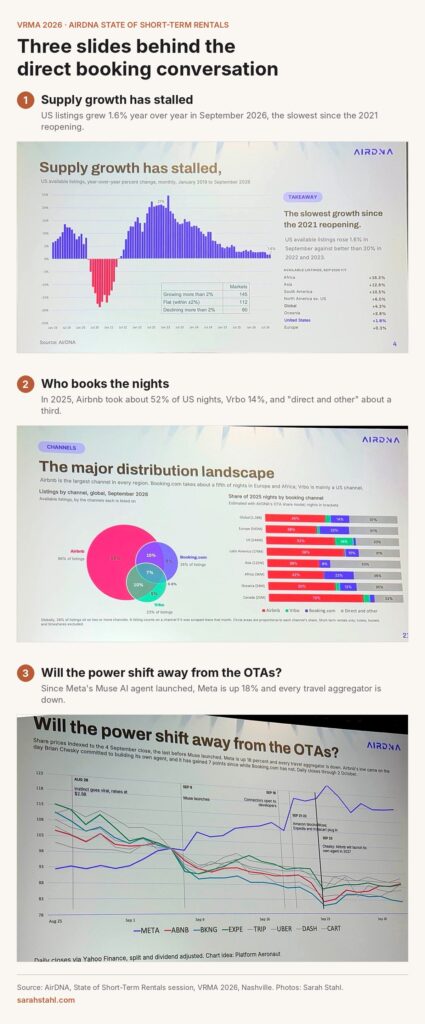
1. Supply growth has stalled. US available listings rose just 1.6% year over year in September 2026, the slowest growth since the 2021 reopening, against better than 20% in 2022 and 2023. Of the US markets AirDNA tracks, 145 are still growing more than 2%, 112 are flat, and 60 are shrinking. The tide that lifted every boat for three years has gone out.
2. The platforms still book most of the nights. AirDNA estimates that in 2025, Airbnb took about 52% of US vacation rental nights and Vrbo about 14%. “Direct and other” took about a third, and that bucket includes more than true direct bookings, so the real direct share is smaller. Airbnb sits on 86% of listings globally. Only 28% of listings are on two or more channels at all.
3. Wall Street is betting the power will shift anyway. AirDNA’s last slide tracked share prices from the day before Meta launched its Muse AI agent. Meta was up 18%. Every travel aggregator on the chart was down, and Airbnb’s spike came on September 23, the day Brian Chesky committed to building Airbnb’s own agent.
None of these slides charts direct share over time, so they don’t prove direct bookings are shrinking. What they show is that after years of book-direct conferences, toolkits, and websites, the needle on who books the nights has barely moved. The movement didn’t collapse. It stalled.
When I read the first two slides together, it seems supply has flattened, so you’re no longer growing into new demand. You’re fighting for the demand that already exists, and most of it still flows through platforms you don’t control. The third slide is interesting becuase it seems the people with money on the line think that control is about to get shaky.
Booking.com: an empty night earns nothing. In a conversation moderated by Nathan Diller of USA Today, Booking Holdings CEO Glenn Fogel made the operator math plain. Vacation rentals carry high fixed costs, so paying a commission to fill a night that would otherwise sit vacant is worth it. He’s right, and I’ve never told an operator to leave a night empty out of principle.
“OTAs Are Not Demand”: the journey is long. One session went past the direct-versus-OTA argument entirely. The panel described an average guest journey of about 71 days from discovery to booking, and split demand into two jobs: demand creation and demand capture. That framing is the most useful thing I heard all week, and I’ll come back to it.
Savvy: travelers want a marketplace. Savvy argued that a direct booking website is a conversion tool, not a discovery tool. From the stage, they said that 70% of direct bookings happen on the back of an OTA search, and that property managers won’t succeed if they try to own the direct booking process on their own. The answer, in their view, is a better marketplace. Theirs.
All four of these point at the same place, demand is the scarce thing. The question is who builds it.

The Website Was Never the Strategy
I’ve sat in three hospitality marketing seats: Tourism, a Resort and an OTA. From my view here’s what I think is really happening. Hosts and property managers were told that a direct booking website was the way out of OTA dependence. So they bought one, and then they waited.
A direct booking website is infrastructure, the checkout counter. It captures demand that already exists. It does not create a single traveler who wasn’t already looking for you.
I wrote about this in Direct vs. OTA Is the Wrong Argument. Arival’s 2026 Global Operator Landscape Study found that about 70% of operators had a direct booking website, nearly two-thirds of them still got under a quarter of their bookings direct, and 18% got none at all. That’s not an awareness issue, nobody buys a booking website by accident. That’s an execution problem.
The “OTAs Are Not Demand” session gave us better language for it. Your business has four jobs, and the website only does one of them:
Job | What it does | Example |
|---|---|---|
Demand creation | Gives someone a reason to want this trip, with you | A creator shows a family reunion at your lake house |
Demand capture | Connects a traveler who is already looking with an option | Someone searches an OTA for a six-bedroom home |
Conversion | Turns interest into a reservation | Clear pricing, credible reviews, a simple checkout |
Retention | Gives the guest a reason to come back and send friends | A memorable stay and relevant follow-up |
OTAs are extraordinary at demand capture. They’re good at conversion. They’re decent at retention, for themselves. What most property managers have never built is demand creation. They bought the conversion layer, left creation to the platforms, and then wondered why the platforms kept getting the credit.
If a guest journey really runs around 71 days, the booking is the last step of a long trip. Where someone completes the booking tells you nothing about who made them want to go.
The Busywork Trap That Keeps OTA Dependence in Place
Once the website is live, the second mistake kicks in. Property managers fill their weeks with the marketing tasks they’ve been told every operator has to do. Send the monthly email. Post three times a week. Keep the Google Ads running. Boost a reel. Start a TikTok because someone at a conference said to.
None of those tasks are a waste. The problem is that they’re being done for their own sake. There’s no strategy deciding why that channel, for which guest, at which point in that 71-day journey. There’s no tracking telling you whether any of it produced a booking. And because there’s no tracking, there’s no pivot, and spend per night stays where it was last year.
I hear the same sentence in almost every first conversation: “We’re doing all the things.” When I ask which of the things is working, the room goes quiet. That’s the whole problem. When you can’t see what’s working, every channel looks equally necessary, so you can’t cut any of them. Your team gets stretched across five half-done efforts. Meanwhile, the OTAs keep delivering bookings you can see, so they keep looking like the only thing that works. OTA dependence isn’t a choice most managers make. It’s what’s left over when nothing else is measured.
Here’s the difference between activity and a system:
Activity | System |
|---|---|
“We send a monthly newsletter.” | “Our post-stay email drives 8% of repeat bookings, so we’re adding a 90-day rebook offer.” |
“We post on Instagram three times a week.” | “Reels from creator stays bring 4x the site visits of our own posts, so we shifted time from posting to hosting.” |
“We run Google Ads.” | “Brand search converts and generic search doesn’t, so we cut generic and moved the budget to creator stays.” |
“We tried influencers once.” | “We host one creator a week with a brief, a booking code, and a follow-up, and we review it monthly.” |
The numbers in that right-hand column are illustrations, not benchmarks. Yours will be different. The point is that a system produces a sentence like that every month, and activity never does.
A system has three things activity doesn’t: a goal you can measure, tracking that ties each channel to bookings, and a regular moment where you move time and money toward what’s working. Without the third one, the first two are just reporting.
Where I Disagree With Savvy
Let me give Savvy its due first, because it’s doing real good for this industry.
Savvy, formerly bnbfinder, is a commission-free marketplace built for professional property managers. Travelers pay no service fees. The manager stays the merchant of record and keeps control of listings, payments, policies, and the guest relationship. It lists more than 150,000 professionally managed rentals. Handing margin and guest data back to the manager is exactly the direction I want this industry to move. If you’re on the fence about adding Savvy as a channel, that’s not what I’m arguing against.
What I disagree with is the evaluation of the direct booking movement that came with the pitch.
The argument went like this: travelers like to book through OTAs, so direct booking sites can only convert, never discover. Property managers won’t succeed trying to own direct booking on their own. So the fix is a better OTA.
That argument has a hidden assumption. It assumes a property manager can’t build a brand and can’t build demand. That travelers will only ever find you because a marketplace showed you to them.
I don’t see that in reality. I built the opposite at a resort that started 100% OTA-dependent, and at VRMA, I watched a property manager from Idaho describe the opposite from the stage. I also heard a similar story from a VRMA panel titled “OTAs Are Not Demand,” where Spencer shared how Bear Lake Luxury Rentals uses creators to drive direct booking goals above 60%.
Yes, plenty of travelers check an OTA before booking direct. That tells you OTAs are where people compare. It doesn’t tell you who made them want the trip, or why they chose to book with you instead of the listing next door. The ability to build your own demand is far from dead.
Bear Lake Luxury Rentals: Proof a Property Manager Can Build Its Own Demand
Spencer Bailey of Bear Lake Luxury Rentals was on the “OTAs Are Not Demand” panel, and he described what I’d call one of the most mature creator systems I’ve heard a property manager talk about publicly.
The session opened on a question I wish every manager asked first: before a guest ever compares properties, why would they trust you? The panel’s answer was brand, defined simply as a clear reason for choosing you, said the same way in every public-facing piece of communication. The example on stage was mission-based: “we’re the family reunion destination of the West.” That’s not a tagline. That’s a filter for every marketing decision you’ll make.
Then Spencer got specific about creators. His core line:
“Don’t sleep on video from creators.”
His point was that the “I’ll stay for free and post” era is over. Every creator stay has to have a defined return. Bear Lake uses utm links so bookings can be traced, and they choose creators who fit their brand, not just creators with the biggest following.
He was also honest about failure. Their first creator stay flopped. That’s common, and it’s worth sitting with, because it’s where most managers quit. One stay, high hopes, loosely defined expectations, and a hunt for quick conversions. That approach is the opposite of building a brand, so of course it disappoints. Then the verdict becomes “creators don’t work,” and the manager goes back to paid ads.
When a property manager in the room asked for the top three things that increase direct bookings, the panel’s answer read more like a system than a tactic list:
- Listen to your guests. Use a survey tool to understand what made their stay incredible, and take the negative feedback seriously enough to fix it.
- Set a direct booking goal, then build toward it. Pick the percentage you want, map the guest journey, and fill it with human outreach and creator marketing.
- Measure everything, early. Put tracking in place before you scale, so you have benchmarks and know what’s working.
Notice what isn’t on that list. “Get a better website.” “Post more.” “Find a better OTA.” Bear Lake didn’t escape the platforms by finding a nicer platform. They built a reason to choose them, a way to create demand, and a way to measure it.
Spencer and I Compared Notes. Here's What We're Tightening.
After VRMA, Spencer and I got on a call to compare the creator systems we’ve each built. Two operators ( I a former, he’s a current), two states, two very different properties, and the same core conclusion: creators work when there’s a system around them. The more useful part of the conversation was where each of us had been leaving bookings on the table.
Here’s what came out of it.
1. Inbound over outbound. Most operators, us included, spend their energy chasing the creators they picked, while the creators who already reached out sit unanswered. A creator who DMs you has already seen your property and imagined staying there. That’s a warmer start than any cold pitch.
“We’ve been sitting on a pile of DMs and only chasing the ones we picked. That’s changing.”
2. Say yes to more creators, but control where they stay. Fit matters, but most of us define it too narrowly, usually by follower count or a perfect aesthetic match. The better filter is whether their audience could plausibly book. Then you control the inventory: which unit, which nights, and how many stays a month.
3. No weekend stays, and the creator covers the clean. This one comes straight from my Creator System. Creator stays run Sunday through Thursday only, and the creator covers the cleaning fee and taxes. You fill nights that would otherwise sit empty, and you never give up a Saturday.
“Simple, and it protects our best nights.”
4. A 10-day content window, with the stay owed if they miss it. The most common creator headache isn’t a bad post. It’s no post. A signed agreement with a 10-day delivery window after checkout, and the value of the stay owed if they miss it, turns “I’ll get to it” into a deadline.
“Love that. It solves our biggest follow-through headache.”
5. A referral loop on every creator code. A booking code tells you which creator drove a reservation. A referral loop keeps that reservation working: the guests who book through a creator’s code get a reason to bring their own friends back, so one stay keeps compounding long after the post scrolls off the feed.
None of these are clever hacks. They’re the difference between a creator program that runs on hope and one that runs on rules. Spencer and I left that call with the same conviction: operators who tighten these five things are going to see their direct bookings climb. And the timing could not be better, because the biggest platform in the industry just gave every host another reason to want a door of their own.
Every Time the Platforms Tighten, Direct Gets Easier to Sell
On November 20, Airbnb’s new house rules policy takes effect for reservations booked from that day on. Hosts will no longer be able to require guests to wash dishes, strip beds, start laundry, or haul trash off-site. Hosts can’t fine guests. Separate rental agreements are mostly off the table. And by default, hosts can’t collect guests’ contact details or ID documents. Listings that keep breaking the rules can be shown to guests with an alert or pushed down in search. (Rental Scale-Up)
Guests will probably love it. Hosts are a different story. One host on Airbnb’s forums, quoted by TechCrunch, put it this way: “Guests are given complete freedom to be lazy while the hosts bear the risk.”
I’m not here to argue about dishes. I’m here to point out the pattern. Line up the last eighteen months and it reads like a single sentence:
When | Platform | What changed for hosts |
|---|---|---|
November 20, 2026 | Airbnb | New limits on house rules, checkout tasks, rental agreements, fines, and guest data collection |
October 29, 2026 | Vrbo | Commission rises to 12%, with new terms requiring your Vrbo listing to be at least as favorable as your other channels |
October 27, 2025 | Airbnb | 15.5% host-only fee for most PMS-connected hosts |
May 2025 | Airbnb | Off-platform policy bars asking for guest emails through Airbnb messaging or using guest contact details for marketing |
Each change has its own logic. Together, they say the same thing: the platform sets the rules, and the rules keep moving in one direction.
So here’s the creative exercise I’d ask every operator to try. Read Airbnb’s November 20 policy as a list of things your own booking channel still lets you do.
On Airbnb, starting November 20 | On your own direct booking site |
|---|---|
Checkout tasks limited to a short list of polite “requests” | Your house rules, priced honestly into your cleaning fee |
Separate rental agreements generally not allowed | Your rental agreement, signed at checkout |
Guest contact details off-limits by default | The guest’s email is the first field in your booking flow |
Fines not allowed | Your policies, clearly disclosed and within local law |
Rule changes after booking don’t count | You decide what changes, and when |
That’s not a complaint list. It’s a direct booking pitch, and Airbnb just wrote it for you.
Here’s my prediction: Each time a platform tightens, more hosts start looking for a door of their own. The ones who already have demand coming through it will feel the tightening as a minor annoyance. The ones who don’t will feel it as a tax they can’t refuse. I expect the first group’s direct share to climb through 2027, not because Airbnb is going anywhere, but because every rule change makes the case for owning your own channel a little easier to make.
Now we’re at the part of VRMA I can’t stop thinking about, and it’s the reason I don’t think managers can afford to wait another year to build their own demand.
On September 8, Meta launched Muse, a personal AI agent that can book travel, fill out forms, and complete purchases on a user’s behalf. Wall Street reacted fast. AirDNA put up a slide titled “Will the power shift away from the OTAs?” It tracked share prices from the last close before Muse launched. Meta was up 18%. Every travel aggregator on the chart was down. Airbnb shares fell about 7% in a single day on reports that Muse could complete stay reservations directly, and analysts cited by Barron’s projected that Muse could eventually handle 5% to 10% of bookings.
The platforms are already picking sides. Expedia agreed to offer hotel bookings through Muse. Amazon blocked Muse from its store on September 20, saying it never agreed to the access. And AirDNA’s chart marked Airbnb’s low on September 23, the day Brian Chesky said Airbnb would launch its own agent in 2027.
Then Chesky said the quiet part out loud. In an October 1 interview with TechCrunch, he said:
“I’ve used Airbnb on Muse and Instinct. And it doesn’t work very well.”
His explanation is the most important thing a property manager can read this year. Vacation rentals don’t fit neatly into an agent’s chat window the way a hotel room does. A home depends on host details, house rules, photos, and conversation, and agents flatten all of that into plain text. Chesky named what’s missing: browsing, messaging the host, comparing listings, identity verification, and maps.
Think about it. Airbnb has more vacation rental data, more reviews, and more engineering talent than any company in this industry. And its own CEO says it doesn’t show up well inside the agents travelers are starting to use.
If Airbnb can’t make your property legible to an agent, you can’t assume your Airbnb listing will carry you through this shift. Your OTA listing is now one more layer removed from the traveler. You don’t control how Airbnb’s page gets read, summarized, or skipped by somebody else’s AI.
What agents will reward
Nobody knows exactly how this plays out, and Muse is weeks old. But the direction of travel came up in session after session at VRMA.
Specific, accurate information. In the distribution session, a Booking.com speaker said that about 60% of traveler pain comes from content friction, meaning information that’s unclear or inconsistent, and that 40% of Booking.com listing photos haven’t been updated in a year. An agent comparing your home to the one next door can’t work with “luxury escape.” It needs sleeping arrangements, accessibility, fees, location, and cancellation terms, stated plainly and the same way everywhere.
A match to what the traveler asked for. Glenn Fogel described where he thinks this goes: a traveler’s agent will hold their standing preferences, reach out on their behalf, and surface only the properties that match. If your positioning is vague, you won’t match anything.
A name the traveler already trusts. This is my bet, not a finding. When a traveler can just tell an agent what they want, the operators who win are the ones travelers ask for by name. “Book the family reunion place at Bear Lake my sister keeps posting about” is a request no marketplace gets credit for. You only get that request by creating demand before the search starts.
That’s why the AI shift doesn’t change the strategy. It shortens the timeline. Clear brand, accurate information, demand you create yourself, and measurement that shows you what’s working were always the way out of OTA dependence. Now they’re also how you stay visible when the search box turns into a conversation. I went deeper on the visibility side in AI Search Didn’t Change the Rules.
I’m not telling you to quit the OTAs. Glenn Fogel is right that an empty night earns nothing, and the OTAs are still the best demand capture machines this industry has. Keep them. The goal is to stop needing them for everything.
That takes a system, and it has five parts. Skip one and the rest stop working.
- A reason to choose you. One clear sentence about who you’re for, said the same way on your website, your OTA listings, your social profiles, and every creator brief. “The family reunion destination of the West” tells a traveler, a creator, and an AI agent exactly when to pick you.
- A demand creation engine. At least one channel that puts you in front of travelers before they search: creators, tourism partners, a guest referral program, local businesses who send people your way. Pick one, run it on a steady cadence, and give it time to compound before you add the next.
- Capture that’s consistent everywhere. Your direct booking website and your OTA listings tell the same accurate story: real photos, plain sleeping arrangements, all-in pricing, clear policies. This is the part agents will read.
- Measurement tied to bookings. A direct booking percentage goal. Unique booking codes in your PMS for every creator and partner. Tracked links on everything. Benchmarks set before you scale, not after. Codes won’t catch every guest who watched a reel and booked later, so track site visits, inquiries, and email sign-ups next to redemptions.
- A pivot cadence. Once a month, look at what each channel produced and move time and money toward the winners. Cut what isn’t working, even if “everyone does it.” This is the step almost nobody does, and it’s the one that turns the other four into a system.
Then you start again at step one with better information. That’s the loop.
A five-minute self-audit
If you can’t answer these without opening five different tools, OTA dependence is your default, not your choice:
- What percentage of last quarter’s bookings came direct, and what’s your goal for next quarter?
- Which single marketing channel produced the most direct bookings last quarter? How do you know?
- Which channel are you spending time or money on that you can’t connect to a single booking?
- Could a traveler, a creator, or an AI agent describe who your properties are for in one sentence after reading your listing?
- When did you last move budget from one channel to another because of what your tracking showed?
- Do your OTA listings and your website show the same photos, fees, and policies today?
Most managers I talk to can answer the first question. Very few can answer the second. That gap is the whole problem. If you want to go deeper on the operational side, I’ve laid out the steps in How to Reduce OTA Dependence.
There are a lot of ways to create demand. I specialize in creators because they solve the problem the OTAs can’t. A creator brings you people who already trust them, before those people ever open a search bar. That’s demand creation in its purest form. And when it’s built as a system instead of a free-stay favor, it’s one of the few demand channels you can trace to a booking.
I didn’t learn that from a conference panel. When I started at ReTreet, every booking we had belonged to Airbnb. Over two years, we hosted one to two creators a week, every week. Every stay had a signed agreement and a brief before arrival, a tracking code on every piece of content, and a follow-up sequence after checkout. We added a referral program and tourism partners alongside it, and we stayed connected to the major OTAs the entire time.
The result was 600 leads a month, a 34% conversion rate, and a shift from 100% OTA to 93% direct. The creators weren’t exceptional. The system made it impossible to fail quietly. I’ve since built the same architecture for a multi-location hotel brand, Wilding Hotels, where direct bookings rose 50%, and inside an OTA marketplace.
Notice how closely that matches what Spencer described at Bear Lake: creators who fit the brand, a defined return on every stay, codes to trace bookings, and the patience to let it compound. Two operators, two states, the same conclusion. Property managers can build their own demand. They just can’t do it with one free stay and a hopeful attitude.
The shortcut was “buy a website and the bookings will come.” That one’s done, and VRMA made it official.
What’s left is the real work: a reason to choose you, demand you create on purpose, information an agent can read, and measurement that tells you where to put your next dollar. The managers who build that over the next twelve months will treat the OTAs as one channel among several. The ones who don’t will be renting their demand from whichever platform, or whichever agent, owns the traveler’s attention next.
If you met me at VRMA, or wish you had, the Creator System is how I build that demand engine for property managers. It’s a done-for-you program: six months, built and run for you, with every creator booking traced to a code in your PMS. Stays run Sunday through Thursday only, so you never give up your best nights.
Vacation rental marketing is my whole thing. I’m an independent marketing strategist, and I connect MarTech and storytelling to clean up the scattered systems between search and stay. I’ve lived the hospitality industry from every angle. I started government-side as a DMO tourism director, managing destination strategy and watching visitor behavior shift in real time — then I jumped to the private side, frustrated by brilliant property owners buried under clunky platforms and vague advice. As Head of Marketing, I scaled a startup resort from six treehouses to 21 units, broke its OTA dependency, and built an influencer system that drove 93% direct bookings and beat revenue expectations in two years, without depending on PPC. I’ve worked with nearly 500 creators across travel, hospitality, and local lifestyle, and I speak on trust-based marketing at industry events including The Uprising. Ready to find the broken part of your system? Book a strategy call.