The Book Direct Toolkit for Property Managers: Everything You Need to Build a Direct Booking System
The complete book direct toolkit for property managers and boutique resort owners — checklists, frameworks, and tools to reduce OTA dependence and build a measurable direct booking system.
Most property managers know they need a book direct strategy. What they don’t have is a place to start that isn’t a 40-page PDF or a generic checklist built for a solo host with three Airbnb listings. That’s why I compiled this book direct toolkit. Not for someone managing real portfolio volume where OTA commissions aren’t a nuisance, they’re a material drag on the business.
This toolkit was built for property managers running 10 to 200+ doors: operators who are already doing meaningful volume, who feel like profit isn’t scaling with bookings, and who are tired of making decisions based on gut feel because the tracking infrastructure doesn’t exist yet. If you’re still in the single-property phase, this will get ahead of where you are. If you’re already at scale, this is the system you should have built six months ago.
I built this book direct toolkit from the inside of that problem.
When I was the Head of Marketing for ReTreet Resort & Spa, I helped take a rural treehouse property from six units and 100% Airbnb dependence to a 21-unit destination resort running at 93% direct bookings — in two years, with less than a sixty-thousand dollar budget. That experience taught me something the generic “reduce OTA dependence” advice usually skips: the sequence matters as much as the strategy.
You can’t market your way out of a broken booking system. You have to build the system first.
I’m Sarah Stahl — currently VP of Marketing at Lake.com, where I sit inside the OTA ecosystem and study how travelers discover and book properties every day. That dual perspective — operator who built direct bookings from nothing, and platform insider who sees how guests actually decide — is what shapes every tool in this framework.
Work through it in order. Each tool builds on the one before it.

Tool 1: The Booking Mix Audit
Before you change anything, you need to know exactly where you stand. Most property managers have a rough sense of their OTA percentage. Very few have the actual numbers broken down in a way that shows the real cost.
Run this audit on your last 90 days of booking data. Pull it from your PMS and fill in the table:
Booking Source Audit — Last 90 Days
Booking Source | # of Bookings | Total Revenue | Commission/Fee | Net Revenue | % of Total Bookings |
|---|---|---|---|---|---|
Airbnb | |||||
Vrbo | |||||
Booking.com | |||||
Direct (website) | |||||
Direct (phone/email) | |||||
Other OTA | |||||
TOTAL |
Three numbers to calculate from this table:
- OTA dependency rate: OTA bookings ÷ total bookings × 100 = ____%
- Annual commission cost: Monthly OTA commission × 12 = $____
- Cost per direct booking: Total direct marketing spend ÷ direct bookings = $____
If your OTA dependency rate is above 70%, you’re in a position where a single platform policy change, fee increase, or algorithm shift can meaningfully impact your revenue without warning. That’s the number this toolkit is designed to move.
(For a deeper look at what OTA dependence is actually costing beyond the commission line, see How to Reduce OTA Dependence: A Property Manager’s Playbook →)
Tool 2: The Direct Booking Website Checklist
The next consideration before you drive a single guest toward your direct booking website, it has to be ready to convert them. Most property management websites aren’t and sending traffic to a site that can’t convert is the fastest way to conclude that direct booking doesn’t work. Work through this checklist on your own site, on a mobile device, before you do anything else.
Homepage & Brand
- The homepage headline states your portfolio’s location and the type of experience guests can expect, in one sentence
- Professional photography is consistent in style across all unit listings
- The brand experience on your website matches what guests see on your OTA listings — same photos, same tone, same story
- Your direct booking value proposition (why book here vs. Airbnb) is visible above the fold on desktop and mobile
- A phone number or chat option is visible on every page
Search & Booking Flow
- Guests can search availability and see pricing in fewer than 2 clicks from the homepage, without a form fill
- The booking engine loads in under 3 seconds on mobile (test at PageSpeed Insights: pagespeed.web.dev)
- Rates and all fees (cleaning, taxes, resort fees) are visible before the final checkout screen
- The checkout process requires fewer than 5 steps to complete
- Guest account creation is optional, not required, to complete a booking
- Apple Pay, Google Pay, or PayPal are accepted alongside standard card options
- A clear cancellation policy is visible during — not after — the booking flow
Trust Signals
- Recent guest reviews are displayed on the homepage or booking pages — not buried in a separate reviews tab
- An SSL certificate is active (https:// in the browser bar)
- Payment security badges are visible on the checkout screen
- A real address, phone number, and response time are visible on the site
- Staff or owner photos appear somewhere on the site — guests book from people they trust
Mobile Experience
- The full booking flow works on an iPhone without pinching, zooming, or horizontal scrolling
- Buttons and CTAs are large enough to tap accurately on a phone screen
- Forms have appropriate keyboard types (number keyboard for phone fields, email keyboard for email fields)
Score your site: Count the unchecked boxes. More than 5 means you have a conversion problem, not a traffic problem. Fix the site before you spend anything on marketing.
Tool 3: The Direct Booking Offer Framework
Rate parity agreements with many OTAs mean you often can’t offer a lower price on your own site. That removes the most obvious reason a guest would book direct — but it doesn’t remove all of them.
A strong direct booking offer gives guests a compelling reason to bypass the platform without requiring you to undercut your OTA rates. Here’s the framework:
The four types of direct booking incentives (choose one per campaign):
- Value-add perks (highest perceived value, lowest actual cost)
- Early check-in or late checkout (when availability allows)
- Welcome gift waiting at arrival (local products, snacks, a handwritten note)
- Free mid-stay cleaning on stays of 5+ nights
- Access to amenities not available through OTA bookings (equipment rentals, concierge services, local guides)
- Flexible policy advantages
- More lenient cancellation terms than your OTA listing (where platform rules allow)
- Flexible check-in/check-out windows
- No guest service fee
- Loyalty and repeat guest offers
- A returning-guest discount code sent via post-stay email
- Priority access to peak-season availability before it goes live on OTAs
- A “book your next stay during this stay” rate for in-property conversions
- Seasonal campaigns with trackable codes
- A seasonal discount code (e.g., SUMMER15) tied to a specific campaign
- Works best when the code is gated behind an email opt-in (see Tool 5)
- Creates a trackable event you can tie back to the campaign source
Offer selection checklist:
- Does this offer give a guest a real reason to book direct vs. through an OTA?
- Can I track which bookings came from this offer?
- Does it work within my rate parity agreement?
- Is the cost of the offer lower than the OTA commission I’d otherwise pay?
- Can I fulfill it consistently across all units without creating operational chaos?
If you answered yes to all five, it’s a viable direct booking offer. Run it for 60-90 days before evaluating results.
Tool 4: The CRM Setup Guide for Property Managers
According to a recent Hostfully Tech Stack Report, the CRM is the piece most property managers say they’ll “set up eventually.” It’s also the piece that determines whether your direct booking system actually compounds over time — or resets to zero after every stay. You don’t need an enterprise CRM. You need a system that does four specific jobs.
Job 1: Capture guest contact information
Every OTA booking should trigger a post-stay data capture effort. You don’t get full guest data pre-stay from most OTAs — but you do get a checkout, and a checkout is an opportunity.
A simple post-stay email (sent from your domain, not the OTA platform) that asks for a review and offers a returning-guest incentive in exchange for direct contact information is the starting point. Most guests who had a good stay will open it.
Minimum data to capture:
- First name
- Email address
- Phone number (for SMS, if opted in)
- Property/unit stayed in
- Stay dates
- Booking source (OTA vs. direct)
Job 2: Tag and segment guests
A flat list of contacts is nearly as useless as no list. Tag every contact so you can communicate relevantly:
Suggested tags:
- Booking source (Airbnb, Vrbo, direct website, phone)
- Property/unit type (cabin, lakefront, downtown, pet-friendly)
- Travel window (summer, ski season, shoulder season)
- Guest type (family, couple, group, corporate)
- Offer engaged (which campaign or code they responded to)
- Repeat guest (yes/no)
Job 3: Automate follow-up sequences
Manual follow-up fails. It fails because your team is managing turnovers, maintenance issues, and a hundred operational fires and “remember to email the guests who checked out last week” loses every time.
Minimum sequences to build:
Post-stay sequence (starts 24 hours after checkout):
- Day 1: Review request + thank you
- Day 7: Returning guest offer (discount code or perk) with direct booking link
- Day 14: “We’d love to have you back” — seasonal availability preview
Abandoned booking sequence (starts 1-2 hours after abandonment):
- Hour 1-2: “You left something behind” — direct link to resume booking
- Day 1: Address common hesitation (cancellation policy, what’s included)
- Day 3: Final nudge with your direct booking offer
Seasonal campaign sequence:
- Announce upcoming availability to your list before it goes live on OTAs
- Include a direct-booking-only rate or perk
- Create urgency around peak dates
Job 4: Track source attribution
Every contact should have a booking source tag that carries through to any future booking. When a guest who originally found you on Airbnb comes back and books direct, that’s the conversion your system is designed to create — and you need to be able to see it.
CRM tools worth considering for property managers:
- Hostfully or Lodgify (PMS-integrated options with basic CRM)
- Mailchimp or ActiveCampaign (standalone email/CRM, works alongside your PMS)
- HubSpot (free tier is sufficient for most PM operations under 50 doors)
Tool 5: The Lead Capture System
This is the bridge between “someone is interested in my properties” and “I have their contact information and can market to them directly.”
Most property management websites have no lead capture at all. Guests either book or they leave, and there’s nothing in between to catch the ones who aren’t ready yet. A lead capture system gives those guests a reason to hand over their contact information before they’re ready to book, so you have a legal, relationship-based way to follow up.
The simplest lead capture that actually works:
A seasonal discount code page — one page on your website that offers a direct-booking discount code (e.g., 10% off your first direct booking) in exchange for name + email + phone.
This does three things simultaneously:
- Gives a not-yet-ready guest an easy “next step” that isn’t a full commitment
- Creates a trackable event you can tie back to the traffic source that brought them
- Starts a follow-up sequence automatically (see Tool 4, abandoned booking sequence)
Lead capture checklist:
- A dedicated opt-in page exists on your site (not a pop-up, a real page with its own URL)
- The offer is specific and compelling (a code, a perk, a seasonal benefit — not “sign up for updates”)
- The form asks for name + email + phone only — no additional fields
- Submitting the form triggers an immediate automated email delivering the offer
- Submitting the form adds the contact to your CRM with appropriate tags
- The page is linked from your homepage, your property pages, and your booking engine confirmation page
- The opt-in offer is mentioned in your OTA listing bio or house manual where platform rules allow
Tool 6: The Direct Booking Tracking Dashboard
If you can’t see what’s working, you can’t improve it. And most property managers are making direct booking decisions based on gut feel because the tracking infrastructure doesn’t exist. Set up this simple dashboard that lives in a Google Sheet, your PMS reporting, or a simple spreadsheet, and update it monthly.
Monthly Direct Booking Dashboard
Metric | This Month | Last Month | 3-Month Trend |
|---|---|---|---|
Total bookings | |||
Direct bookings (# and %) | |||
OTA bookings (# and %) | |||
Revenue from direct bookings | |||
OTA commission paid | |||
Cost per direct booking | |||
New email/CRM contacts captured | |||
Repeat booking rate | |||
Abandoned booking recovery rate |
The three numbers that actually tell you if your book direct strategy is working:
- Direct booking percentage — is it trending up month over month? Even 1-2% improvement per month compounds significantly over a year.
- Cost per direct booking — as your system matures, this should decrease. High cost per direct booking usually means a traffic problem (you’re paying to acquire visitors) or a conversion problem (visitors aren’t completing bookings).
- Repeat booking rate — this is the metric that reveals whether guest ownership is working. Direct guests who return are the compounding return on every CRM and post-stay investment you make.
Tool 7: The 90-Day Book Direct Launch Plan
If you’re starting from scratch — or close to it — this is the sequence that builds a direct booking system without disrupting your current occupancy.
Month 1 — Foundation
- Complete the Booking Mix Audit (Tool 1)
- Run the Direct Booking Website Checklist (Tool 2) and fix any items blocking conversion
- Choose and set up your CRM (Tool 4)
- Build your post-stay email sequence (Tool 4, Job 3)
- Create your direct booking offer (Tool 3)
- Build your lead capture page (Tool 5)
Month 2 — Launch
- Launch your direct booking offer to any existing guest contacts you have
- Add your lead capture page link to your OTA listing bio and house manual where allowed
- Send your first post-stay sequences to guests who checked out this month
- Set up your tracking dashboard (Tool 6) and record your baseline numbers
Month 3 — Optimize
- Review your dashboard — which source is driving the most direct booking leads?
- Check your abandoned booking rate — do you have a recovery sequence running?
- Identify your highest-converting unit or property type — double down on promoting it directly
- Set your 6-month OTA dependency rate target (aim for 5-10% improvement from baseline)
Where to Go From Here
A book direct toolkit only works if it gets built. The operators who reduce OTA dependence aren’t the ones with the best strategy documents — they’re the ones who set up the system, even imperfectly, and iterate from there.
If you’ve worked through this toolkit and want a second set of eyes on your specific setup — your website conversion path, your offer structure, your CRM configuration, or your tracking gaps — that’s exactly what a strategy session with me covers.
You’ll walk away with a prioritized list of what to fix first, a measurement strategy so you’re not guessing, and a realistic sequence for shifting your booking mix without disrupting current revenue.
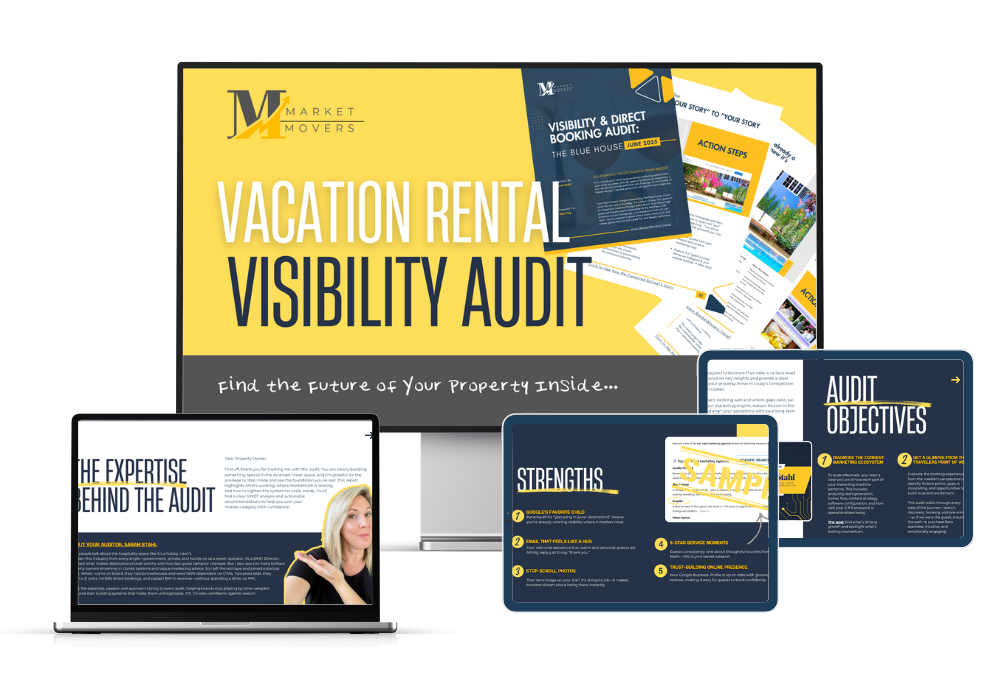
Or start with a guided look at where your visibility is leaking: Vacation Rental Visibility Audit →
Related reading: