From More Content to More Bookings: The Framework That Makes Marketing Actually Convert

If you’ve ever hired “marketing help” and ended up with more content, more spend, and more questions… you’re not alone.

I see this all the time in vacation rentals and boutique hospitality. A team tries to “do marketing,” but no one starts with an audit to make sure the tech stack can actually do its job: capture demand, track what’s working, and convert leads quickly. So growth stays slow and murky until you get a random spike because a third-party platform gives you a temporary boost, or your ad budget happens to land in the right place for once.

That’s why my work as a vacation rental marketing consultant looks different. I don’t just “run campaigns.” I help property owners build systems where marketing and technology work together, on purpose, so that you can increase controlled bookings outside third-party platforms.

The Real Problem: Your Property's Marketing Strategy Doesn’t Have a Booking System, It Has “Activities”

Most marketing doesn’t fall apart because people aren’t trying. It falls apart because everyone’s trying… in different directions.

It usually starts with good intentions. Someone says, “We need more direct bookings,” so the team does what they can do fast: a couple influencer stay invitations go out, a few blog posts get published, and an ad campaign gets turned on. For a minute, it even feels like progress. There’s activity, there are posts, there are even clicks.

But then the questions start creeping in.

  • “Did that creator actually drive bookings or just likes?”
  • “Which blog brought that guest in?”
  • “Why are inquiries up but bookings flat?”
  • “Where did those leads go?”
  • “Wait… who’s tracking all this?”

And suddenly you realize what’s really happening. Marketing is generating noise, but nothing underneath it is built to catch the demand when it shows up. The website exists, but it’s not guiding people toward a decision. The CRM exists, but it’s either ignored or so messy it’s basically a junk drawer. So every push becomes a gamble. When it works, it feels like luck. When it doesn’t, it’s exhausting.

No judgment. This is the default setup for a lot of teams because nobody’s been assigned the job of orchestrating the whole journey end to end. Everyone owns a piece, but no one owns the system. And that’s the shift, direct bookings don’t come from isolated tactics stacked on top of each other. They come from an orchestrated path that makes sense to a real human.

Trust first. Then a clear offer. Then an easy way to capture interest. Then follow-up that doesn’t rely on someone remembering to “circle back.” Then the booking. This is the work that earns the repeat stay and the referral that makes growth feel steadier instead of frantic.

A Quick Story: When an “Unknown” Property Earned 93% Direct Bookings in 12 Months

ReTreet Resort wasn’t starting from “we just need to optimize a few things.” They were starting from the kind of place a lot of properties quietly live in. The brand was basically invisible unless you already found them on a third-party platform. The platform owned the guest relationship, the trust, the discovery… everything. 

And direct bookings? They weren’t a channel. They were a wish.

So when we started working together, the answer wasn’t “post more” or “spend more.” That’s the advice everyone gets, and it usually just creates more motion without more control. The real goal was simpler and harder all at the same time. Build a system that could create trust and then convert that trust into bookings in a way we could actually measure.

We treated trust like something to engineer, not just hope for. We built a weekly creator engine designed to generate steady proof—real context, real credibility, real reasons to believe this place was worth choosing. But we didn’t stop at “content.” Because content without capture is just… content, not conversion.

So we tied that demand to a seasonal offer that made sense for the guest and made sense for the business. When someone downloaded a discount code, that wasn’t the end of the interaction, it was the beginning of a tracked journey. That single action became the trigger that moved a lead into the funnel where we could follow up quickly and consistently.

And this is where most teams break down, follow-up. Everyone has good intentions, but when follow-up relies on someone remembering to chase leads between check-ins, turnovers, and a thousand operational fires, it doesn’t happen the way it needs to.

So we built a CRM pipeline that did what a good system should do, it made the next step obvious and automatic. The follow-up wasn’t a manual hustle. It was staged, timed, and aligned with how real people decide—fast when they’re warm, supportive when they’re on the fence, and clear when it’s time to book.

That’s how ReTreet went from platform-dependent and market invisible to 93% direct bookings within 12 months. And it’s how 34% of those leads booked within 18 hours. Not because staff was glued to their phone, but because the system did its job.

Those results came from orchestration. Trust that was intentionally built, an offer that was trackable, and follow-up that didn’t rely on hope. That’s the difference between marketing and a booking machine.

The Lesson: Marketing Without Tech Is Just Expensive Guessing

If you want measurable direct bookings, marketing and technology have to work together on purpose. There’s no wiggle room here. Not in theory. Not “eventually.” In the actual, everyday way your business runs.

Because here’s what I’ve watched happen—over and over.

A team gets excited about demand and the ideas start pouring in. They bring in creators, the content looks great, and for a minute it feels like momentum. Then they invest in SEO, and traffic starts to tick up. Maybe they layer on ads to “speed things up,” and suddenly there are clicks coming in from all directions.

And yet… direct bookings still don’t feel controlled. They feel moody. Random. Like you’re doing everything “right,” but the results won’t sit still long enough to repeat them. That’s the moment where the real issue shows up. Interest is being created, but it’s not being captured. Traffic is arriving, but it’s not being converted. Clicks are happening, but nothing is being built that keeps people connected to you after that first touch.

Creators can absolutely spark trust, but trust doesn’t magically turn into a booking if there’s nowhere for it to go. SEO can absolutely bring in the right people, but the right people still need a clear path to say yes. Paid can absolutely get attention, but attention isn’t loyalty, and it definitely isn’t a relationship you own.

So if your tracking is fuzzy and your CRM is messy, you end up doing the business version of watering a garden with holes in the hose. You keep pouring effort in… and you can’t figure out why it’s still not growing the way it should.

That’s why I don’t start with “more marketing.” I start with the system.

So, let’s talk framework.

My Vacation Rental Marketing Consultant Framework: The Orchestrated Booking System

This is the system I walk property managers and boutique resorts through who want controlled bookings outside third-party platforms. Meaning, bookings you can trace back to a specific source, replicate on purpose, and scale without feeling like you’re gambling every month.

Step 1 — Diagnose the Leaks with a Direct Booking Audit

Before we add anything new, we figure out why your current demand isn’t turning into booked stays. Most brands don’t have a “traffic problem”, they have a friction problem. People are interested, but something in the path makes them hesitate, bounce, or go back to the easier option. So we audit the full direct booking journey the way an actual guest experiences it, not the way a team assumes it works.

We look at your website conversion path: where people land, what they click, where they stall, and what questions are left unanswered. In vacation rentals, the common drop-offs are predictable rates and fees feel unclear, availability is clunky, policies feel risky, or the booking engine feels like a maze.

We assess trust signals: not just “do you have reviews,” but do you have the right proof in the right moment. Guests don’t need random testimonials buried on a page. They need reassurance exactly when they’re deciding. Things like: “Is this legit?” “Will this be clean?” “Will anyone help if something goes wrong?” “Is this worth the price?

Then we look at offer structure. Is there a reason to book direct that’s compelling, trackable, and aligned with your margins? A good offer isn’t always a bigger discount. Sometimes it’s a value-add, a perk, a flexible policy, or a seasonal code tied to a campaign we can measure. The key is that it’s intentional, something we can connect to a specific source and follow through the funnel.

We also identify booking friction. Where the process feels annoying, confusing, or slow. Small things create big losses here—too many steps, missing FAQs, unclear fees, no clear next action, or no follow-up when someone abandons the process.

And we check for listing vs site mismatch. Because if your third-party listing tells one story and your website tells another, guests feel the inconsistency. And inconsistency kills trust. Your site has to “continue the story,” not restart it.

This step results in a deliverable in the form of a prioritized plan your team can actually execute. Not a 40-page teardown. More like: “Fix these 5 things first, in this order, because they will unlock the most direct bookings fastest.” This is how we avoid the classic fate of becoming another “marketing idea doc” that dies quietly in a Google Drive folder.

Step 2 — Make Demand Trackable 

If you can’t see what’s working, you can’t scale it. And in hospitality, the hardest part isn’t getting demand, it’s knowing which demand is actually converting. This is where a lot of “marketing help” goes sideways. People will run creators, SEO, ads, partnerships… and still have no clean answer to: “What’s driving bookings?” So the team makes decisions based on feelings, not data. And then the budget gets moved around every month like a guessing game.

This matters because referral codes can become a black hole. Creator links get shared or screenshotted and you lose attribution. Your “best channel” changes seasonally without you noticing. And most importantly, you can’t tell the difference between traffic and intent.

So we set up tracking that matches reality. Not perfect-world attribution—real-world attribution. With the right systems in place, we track where leads came from (creator A, creator B, organic search, paid, email, partnership). We can show you how to tie each source to a specific offer or landing path. We measure meaningful actions: code downloads, inquiry submits, booking engine starts, abandoned booking steps. Then we connect that to outcomes: what booked, how long it took, and what follow-up actually moved the needle.

Once that’s in place, “marketing performance” stops being a vague conversation and becomes something you can improve like a real system.

Step 3 — Capture Demand the Way Guests Actually Decide

This is the part most businesses skip because they’re understandably eager for the booking. But asking for the booking before you’ve earned the booking is like proposing on the first date.

Most guests don’t go from “saw a post” to “booked a stay” in one step. They circle. They compare. They ask a partner. They get distracted. They come back. They forget. And the brands that win are the ones that give that guest a clear next step before they disappear. That’s why the turning point in both ReTreet Resort wasn’t “more content.” It was building a lead path that matched human decision-making. 

Trust first: creators, social proof, real context, believable experiences that make someone feel safe choosing you.

Offer second: something that makes sense in the moment and gives them a reason to take the next step.

Capture third: name + email + cell only when it’s logical—when they’re raising their hand, not when they just arrived.

A seasonal discount code download is a great example because it does three jobs at once:

  1. It gives the guest an easy “next step” that isn’t a full commitment.

  2. It creates a trackable event you can tie back to the source.

  3. It sets up follow-up that feels helpful, not pushy.

This isn’t about bribing people. It’s about building a bridge between interest and booking and making that bridge measurable.

Step 4 — Convert Leads Without Hustle 

This is the controlled bookings part. This is where the business stops relying on someone’s memory and starts relying on a system. Because if your CRM is messy, it doesn’t matter how much demand you generate. Leads will leak. Follow-up will be inconsistent. And the guest will do what guests do: choose the easiest option.

When the CRM is clean and stages are clear, the internal conversation changes.

It stops being: “Did anyone reply to that inquiry?
And becomes: “We know exactly where every lead is, what they engaged with, and what they need next.

That’s not just nicer. It’s faster. And speed matters in bookings.

So we clean up how leads enter the system, how they’re tagged/segmented (source, property, travel window, offer engaged), and what happens next. We build follow-up sequences that match the booking timeline: immediate nudges for hot leads, reassurance and social proof for fence-sitters, deadline reminders when the offer has urgency, and post-stay loops for repeat/referral.

Step 5 — Turn Paid Into a Lever 

Another instance where I had the chance to put this into practice was with Wilding Hotels. They are a perfect example of what happens when paid is doing all the heavy lifting. They were spending around $5k/month on ads and nearly 100% of bookings were attributed to paid spend. That’s not growth, that’s renting demand. The minute you reduce spend, the momentum disappears.

So the goal wasn’t “kill ads.” The goal was to stop being dependent on them.

We tightened and systematized the creator engine so demand wasn’t only coming from spend. We cleaned up the CRM so leads were tracked, segmented, and followed up consistently. And we built a lead path that matched how guests decide: trust → offer → follow-up → booking.

In 90 days, direct bookings increased 50%. Paid-driven bookings dropped from nearly 100% to about 50%. Lead capture scaled to around 800 leads per month (name + email + cell in exchange for a direct booking discount code).

And the real win wasn’t “we ran creators.”
The win was orchestration.

Creators generate demand.
The site captures it.
The CRM converts it.
Paid becomes optional, and then strategic.

That’s the system. That’s how you move from unpredictable spikes to controlled bookings you can measure, repeat, and grow—without adding more chaos.
Bookings Shouldn’t Be a Guessing Game—Let’s Fix the System

If you made it this far and you’re feeling a little “oh wow… that’s us,” take that as a good sign. Not because you’ve been doing anything wrong, but because you’re seeing the real issue clearly: you’ve been trying to fix a systems problem with more marketing. And once you can name it, you can actually solve it.

Your efforts probably look like this, you’re getting traffic, but it’s not turning into inquiries. Or you’re getting inquiries, but they’re not converting fast enough. Or you’re working with creators, but you can’t tie any of it to actual bookings. Or your CRM exists in theory, but in practice it’s a messy list that no one trusts—so follow-up happens inconsistently, and leads quietly slip away.

And if you can’t clearly answer “Where did this booking come from?” then you’re stuck making decisions based on assumptions. Which means you’ll keep spending money trying to recreate results you can’t even explain.

That’s not a motivation problem. It’s not a “post more” problem. It’s a system problem.

This is exactly where I come in.

When you book time with me, you’re not buying a random campaign or a handful of ideas. You’re getting a cleanup and an orchestration plan—built specifically for property managers (10–200+ doors) and boutique resorts who want measurable direct bookings outside third-party platforms.

Here’s what that typically looks like:

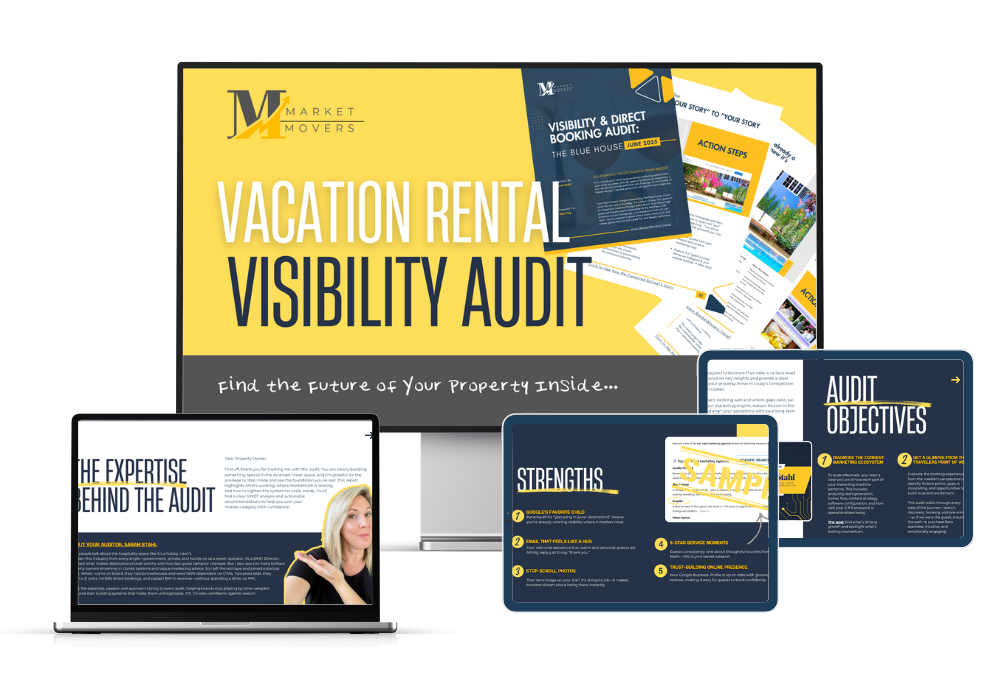
First, we run a Direct Booking Audit. We find what’s leaking money right now—your website path, your trust signals, your offer structure, your booking friction—and we turn it into a prioritized plan your team can actually execute.

Then we fix the measurement problem. I show you or your team how to set up CRM + attribution + automation so leads don’t disappear, referral codes don’t turn into a black hole, and “marketing performance” becomes something you can actually see and improve. And if creators are part of your growth plan (or you want them to be), we can build the Creator/Influencer Demand Engine the right way—so it supports the tech instead of floating beside it. Creators generate trust. 

Your website captures demand. Your CRM converts it. Follow-up runs without hustle. Bookings become trackable. Repeat and referrals become intentional.

Marketing and tech have to talk. I make them speak the same language. Now the part I won’t bury: I only take a limited number of consulting hours each week. Not as a gimmick—because this kind of work needs real attention and hands-on cleanup. If you’re ready to stop guessing and start building a direct booking system you can actually run, book a consult call.

You’ll walk away with clarity and a plan:
A clear diagnosis of what’s breaking
A prioritized cleanup roadmap
A measurement strategy so you’re not guessing
A repeatable path to direct bookings that doesn’t depend on third-party platforms or constant ad spend

Email
Twitter
LinkedIn
Reddit