AI Search Visibility for Vacation Rentals: How to Show Up Where Travelers Are Actually Deciding
Vacation rental AI search visibility is the gap most operators don’t know they have until they run the test themselves.
Open ChatGPT or Perplexity in an incognito window. Type something a real traveler would actually ask: “What are the best lake house rentals for a family of six in the Smoky Mountains?” or “Can you help me find a trusted vacation rental with a private dock in the Southeast?” Note which brands appear. Note which don’t.
For most vacation rental operators — even strong, established ones — the answer to that second question is: yours doesn’t.
The traditional discovery funnel — Google search → OTA → compare → book — is fracturing. Gartner forecast that traditional search engine volume will drop 25% by 2026 due to AI chatbots and virtual agents. The modern traveler’s journey now touches four completely different visibility surfaces, and a vacation rental brand that’s visible in only one of them is invisible for the majority of the decision.
Travelers use AI to narrow their options, not to make the booking for them. AI drives discovery. The booking happens after. Learning if there’s a gap there matters because it tells you exactly where the discovery funnel problem lives for most operators: early. Before the comparison. Before the booking intent crystallizes. In the phase where a traveler is still forming preferences rather than evaluating specific options. And that early-funnel discovery phase is almost entirely invisible to operators whose visibility strategy begins and ends with OTA optimization.
About a year ago I published a piece predicting that PR pros were becoming the unsung heroes of AI search. The industry was shifting, search results were changing in ways most marketers hadn’t named yet, and I was drawing a line that felt risky to draw publicly. AI search visibility wasn’t something people were building strategies around. It was something they were watching, speculating about, waiting to see if it would matter.
Today, I am no longer speculating, but taking vacation rental AI search visibility a layer deeper.
What I want to do here is something I rarely see done, which is to walk through exactly how this played out in practice — with real partners, over several months, inside a company that cannot compete with industry giants on ad spend and never tried to. Because the lesson is not that PR is a nice addition to your marketing mix. The lesson is that in the AI search era, earned credibility is the infrastructure every vacation rental brand needs to build, and most aren’t.
What AI Search Visibility Means for Vacation Rentals And Why Most Operators Are Missing It
Vacation rental AI search visibility refers to whether and how your brand, property, or platform appears when a traveler uses an AI-powered tool — ChatGPT, Perplexity, Google AI Overviews, Claude, Gemini — to plan a trip or find accommodations.
This matters because the way travelers search for vacation rentals is changing faster than most operators realize.
A few years ago, the search journey looked predictable: Google a destination, compare OTA listings, book. Today, a growing share of travelers — particularly families planning longer trips — start with a conversational AI query before they ever open a booking platform. They ask:
- “What are the best lake house rentals for a family of six in the Smoky Mountains?”
- “Can you help me find a safe and trusted vacation rental for my family?”
- “What are the best places to rent a cabin near a lake in the Southeast?”
The AI answers those questions by pulling from sources it has already decided are credible. If your brand, your platform, or your property isn’t in those sources — through editorial coverage, reviews, data citations, or structured web presence — you are invisible at the moment a traveler is actively deciding where to go.
This is not a future concern. It is a present one.
A recent CraftedStays study analyzing 160 AI-generated responses across ChatGPT, Perplexity, Gemini, and Claude found that unbranded trip-planning queries are dominated by a small number of brands that AI engines have decided to trust. For most operators, citation rates collapse to 10–15% on those queries. That means the vast majority of vacation rental brands — even strong, established ones — simply don’t appear when travelers ask AI where to go.
The Biggest Mistake Vacation Rental Operators Make With AI Search Visibility
The dominant conversation in vacation rental marketing right now is about GEO — Generative Engine Optimization. How do you get ChatGPT or Perplexity to surface your brand? Most of the advice centers on technical fixes: structured data, schema markup, faster websites, FAQ content that mirrors how AI engines parse queries.
That advice is not wrong. It is just incomplete.
AI does not rank pages. It cites sources it has already decided are credible.
That decision was made long before the traveler typed their query. It was made over months of editorial coverage, data-backed storytelling, and real publications choosing to write about a brand because they were given something worth writing. This shifts the traditional SEO planning conversation entirely — because you can no longer optimize your way into that position after the fact. You have to build toward it.
AI doesn’t rank. It cites. And what it cites is what the internet has decided is credible over time — before the traveler ever types the question.
The brands dominating vacation rental AI search visibility right now are not the ones with the biggest content teams or the most aggressive keyword strategies. They are the ones that accumulated editorial coverage in publications that AI engines treat as authoritative sources. Earned media is the raw material. PR is the engine that produces it.
Does PR Actually Improve AI Search Visibility for Vacation Rentals? Here's the Mechanism
Yes, and here is the specific mechanism, not the hand-wavy version.
When a journalist at a credible publication (Travel + Leisure, Condé Nast Traveler, Skift, a regional lifestyle outlet, a respected industry trade) writes about your brand with factual specificity — a data point you provided, a trend you represent, a category you can credibly claim — that article becomes a source.
AI engines are trained on the open web. When they are asked a travel question, they pull from sources that appear credible, well-cited, factually grounded, and frequently referenced by other credible sources. An article in Travel + Leisure about the sunniest lake destinations in the U.S. that mentions a specific platform or property is not just brand awareness. It is a data point in the model that the engine draws from when a traveler asks a similar question.
The chain works like this:
Trusted data → fact-based PR angles → editorial coverage in authoritative publications → AI citation infrastructure → traveler discovery at the moment of decision
Every link matters. PR without data is just a pitch. Data without PR stays inside the company. Editorial coverage in a low-authority outlet doesn’t move the needle. The strategy only works when all three elements are in place and that is what makes it genuinely difficult to execute and genuinely defensible when it’s built.
The FAQ Most Operators Are Asking Right Now
How long does it take for PR to improve AI search visibility?
Longer than paid advertising, shorter than SEO. Most brands who commit to a consistent earned media strategy begin seeing AI citation improvements in 3–6 months. The key word is consistent — sporadic placements don’t build the citation infrastructure that compounds. This is a slow-build strategy that accelerates once momentum exists.
Should AI search visibility come out of my SEO, PR, content, or demand gen budget?
Practically, it lives at the intersection of all four — which is why it often falls through the gaps in team budgets. The most effective way to fund it is to treat it as a separate line item: “earned authority” or “AI visibility investment.” For most vacation rental operators, this doesn’t require hiring a large agency. It requires one PR partner with hospitality-specific expertise, one reliable data source, and a clear brand narrative to execute around.
Should a vacation rental trade association hire a PR firm or invest in an AI visibility platform?
Both address different parts of the problem. A PR firm builds the editorial coverage that creates citation infrastructure — the organic, trust-based authority that AI engines draw from. An AI visibility platform typically optimizes existing content for AI readability (schema, structure, FAQ formatting). The sequencing matters: if you don’t have editorial authority to draw from, optimizing for AI readability produces minimal results. Build the authority first.
Does PR for AI search require a large budget?
No — and this is important. The discipline I developed working with a $30,000 annual marketing budget in an earlier role taught me that resource constraints force precision about what actually builds authority versus what merely looks like it does. A focused engagement with one PR partner who genuinely understands the vacation rental industry and can place factual, data-backed stories in the right publications outperforms a broad retainer that produces generic placements.
What’s the difference between PR for AI search and traditional PR?
Traditional PR focuses on brand awareness and reach — how many people saw the coverage. PR for AI search focuses on citation authority — whether the outlets covering you are ones that AI engines treat as credible sources. A placement in a trade publication with 50,000 readers but high domain authority and AI citation rates is worth more for AI visibility than a placement in a high-traffic outlet that AI engines don’t frequently draw from. The measurement framework is different.
Can I improve AI search visibility without PR?
Partially. The technical layer — structured data, schema markup, clear property descriptions, FAQ content, well-organized website architecture — is within your control and worth building regardless. It makes your existing content more legible to AI engines. But it doesn’t produce editorial citations, which is what drives the most significant AI visibility gains. Think of the technical work as the floor and the PR work as what builds above it.
I Tested AI Search Visibility for Vacation Rentals in an Incognito Window. Here's What Came Back
In my professional role as VP of Marketing at Lake.com, I am acutely aware of two things. First, we are filling a real hole in the marketplace — a platform purpose-built for lake house vacations, built around a vision of bringing families together outdoors. Second, we cannot compete with major OTA players from an ad budget standpoint. That is not a complaint. It is a constraint that forced clarity and creative thinking.
So we made a deliberate decision about four months ago. Instead of chasing paid visibility we could not sustain, we committed to building the kind of credibility that AI search engines recognize and cite. That required a long game, specific partners, and the discipline not to expect quick results.
Here is how I know it is working.
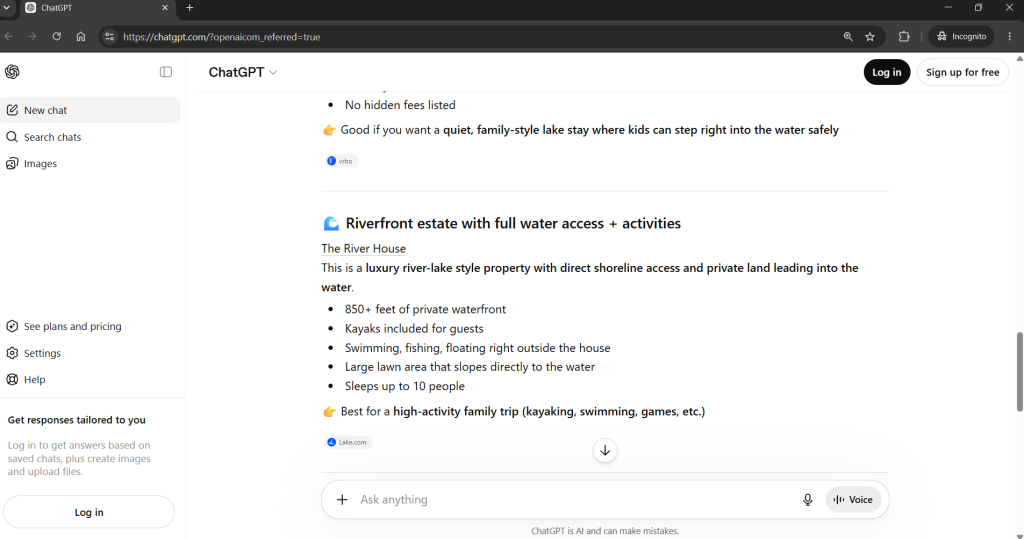
In an incognito Chrome window, using a free version of ChatGPT — not tied to a personal login, no browsing history shaping the response — I typed one prompt: “Can you help me find a safe and trusted house vacation rental for my family?”
Lake showed up. Naturally. In two steps. Alongside Airbnb and VRBO.
That is not an accident. It is the result of a system built specifically to produce that outcome — and it is replicable.
The Three-Part System That Built AI Search Visibility
Part 1: A PR Partner Who Understands the Vacation Rental Industry
We work with Andrea and the team at OHPR, and this relationship matters for a specific reason that has nothing to do with agency size or retainer cost.
PR agencies that understand the vacation rental and travel industry at a structural level — who the editors are, what publications like Travel + Leisure are interested in covering versus a trade publication versus a local lifestyle outlet — can connect a data angle to the right room at the right time. That is not a generic skill. It is industry-specific expertise, and it is the difference between a pitch that sits in an editor’s inbox and a pitch that becomes an article.
Story placement at this level is not about brand awareness. In the AI search era, it is citation infrastructure. Every time a credible editorial outlet covers a brand with specificity — a data point, a trend angle, a named category — that coverage becomes a source AI engines can draw from. It builds the record.
This is why the choice of PR partner matters more for vacation rental AI search visibility than it did in the traditional SEO era. A partner who can place stories in publications with high AI citation rates is doing fundamentally different work than one who produces coverage in high-traffic but low-authority outlets.
Part 2: Vacation Rental Data That’s Worth Citing
PR without facts is just a pitch. The reason earned media works for AI visibility is that it gives journalists something factual to write about — and gives AI engines something specific to cite.
That is why I work with Jeff Brown at IntelliHost as a data partner. The reasoning is specific: clean, reliable, market-specific data gives a PR partner something to walk into a journalist’s inbox with — a real angle, grounded in numbers, that a writer at a trusted publication can use without having to do the primary research themselves. That is what gets stories written. And written stories in authoritative publications become AI citations.
The chain is direct and each link is non-negotiable:
- Trusted data produces fact-based angles
- Fact-based angles earn editorial coverage
- Editorial coverage in authoritative publications builds AI search credibility
- AI search credibility gets you in front of a traveler at the exact moment they are making a real booking decision
That chain does not work if any link is weak. Data that isn’t clean doesn’t get used. Angles that aren’t specific don’t earn coverage. Coverage in non-authoritative outlets doesn’t build AI citation infrastructure.
Part 3: A Vacation Rental Niche Position Clear Enough for AI to Recognize
The third part is less tactical and more strategic, and it’s the one most operators underestimate.
Lake.com occupies a specific, niche marketplace position: lake house vacations, family travel, water-forward experiences. That clarity is not just a brand decision. It is a discoverability decision.
AI engines are better at surfacing brands that stand for something specific than brands that compete on breadth. When a traveler asks an AI tool about lake house rentals for a family vacation, a platform that is specifically and explicitly about that category has a structural advantage over a general marketplace that happens to include lake houses among millions of other listings.
This applies to vacation rental operators at every scale. A property manager whose portfolio is specifically curated around family-friendly mountain cabins with outdoor amenities is more citable on a narrow, high-intent query than a general portfolio that covers the same geography. The narrower and more specific the niche, the more clearly AI engines can associate the brand with a category of travel — and surface it when that category is searched.
The Honest Part Most Vacation Rental Marketing Content Skips
This is not a quick fix.
I have spent years working this cycle in past roles, and the months we spent building this foundation for Lake.com would have produced nothing visible if we had focused on the marketing tasks most vacation rental operators fall back on — more posts, more ads, more generic content.
Credibility does not compound the way paid campaigns do — fast at the top, fast to disappear. It compounds slowly, then suddenly. The Travel + Leisure placement we earned, alongside several other trusted industry resources from the past two months, is not a quick result. It is months of consistent, disciplined work becoming visible.
It also does not require a massive budget. The discipline that a $30,000 annual marketing budget taught me in an earlier role was that resource constraints force you to be precise about what actually builds authority versus what merely looks like it does.
Paid visibility looks fast and feels certain. Earned credibility looks slow and feels uncertain. But in AI search, only one of them survives the query.
How Vacation Rental Operators Can Start Building AI Search Visibility This Month
The question most vacation rental marketers ask is: “How do I show up in AI search results?”
It is the right question and the wrong frame simultaneously.
The frame that produces results is: “What would make us worth citing?”
Not what tags, not what schema, not what prompt optimization strategy. What would make a journalist at a publication that AI trusts decide to write about your vacation rental brand — specifically, factually, in a way that can be sourced and verified?
- Run the vacation rental AI visibility test — today. Open ChatGPT, Perplexity, and Google AI Overviews in incognito windows. Search the unbranded queries your ideal guests actually ask — not your property name, but the category of experience you offer. “Best lakefront vacation rentals for families in [your region].” “Trusted vacation rental with outdoor space near [your destination].” Note which brands appear. Note which don’t. That is your competitive landscape for AI search visibility right now, and it takes fifteen minutes to map.
- Identify the data you already own. Booking patterns by guest origin, repeat guest rates, seasonal demand curves, the specific type of guest your property attracts — any proprietary insight that could anchor a PR story. Clean, specific data you own is the most defensible raw material for AI citation building. Most vacation rental operators have more of this than they realize.
- Map your editorial targets by AI citation authority, not reach. Which publications does your ideal guest trust for travel inspiration? Which trade outlets do hospitality journalists in your space read and cite? Those are your PR targets — not in terms of follower count, but in terms of whether AI engines draw from them when answering travel questions.
- Decide who owns this for your business. Whether you run AI visibility building internally or with a PR partner who understands vacation rental specifically, someone needs to own the discipline of pitching, tracking placements, and measuring citation rates over time. This doesn’t work as a passive strategy — and it doesn’t work as a one-time campaign.
- Take the technical step this week regardless of where you are on the PR side. Add FAQ schema markup to your direct booking website. Replace superlative language in your listing descriptions (“stunning views,” “perfect location”) with specific, verifiable language — named landmarks, exact distances, confirmed nearby amenities. These technical changes make your existing content more machine-readable to AI engines while the editorial authority work compounds in the background.
AI search visibility in vacation rental marketing is no longer a speculation. The research exists, the data gap is documented, and the brands showing up consistently in unbranded trip-planning queries are not getting there by accident. They are getting there the same way trust has always been built — by earning it, systematically, in public, over time.